The most marketable software in the portfolio for small and mid-sized businesses — the stack a property shop, contractor, or service business buys piece by piece: phones answered, sites watched, secrets checked, rent rolls read, compliance kept.
MarciAi — AI Reception Supervisor (call routing) *
Now onboarding
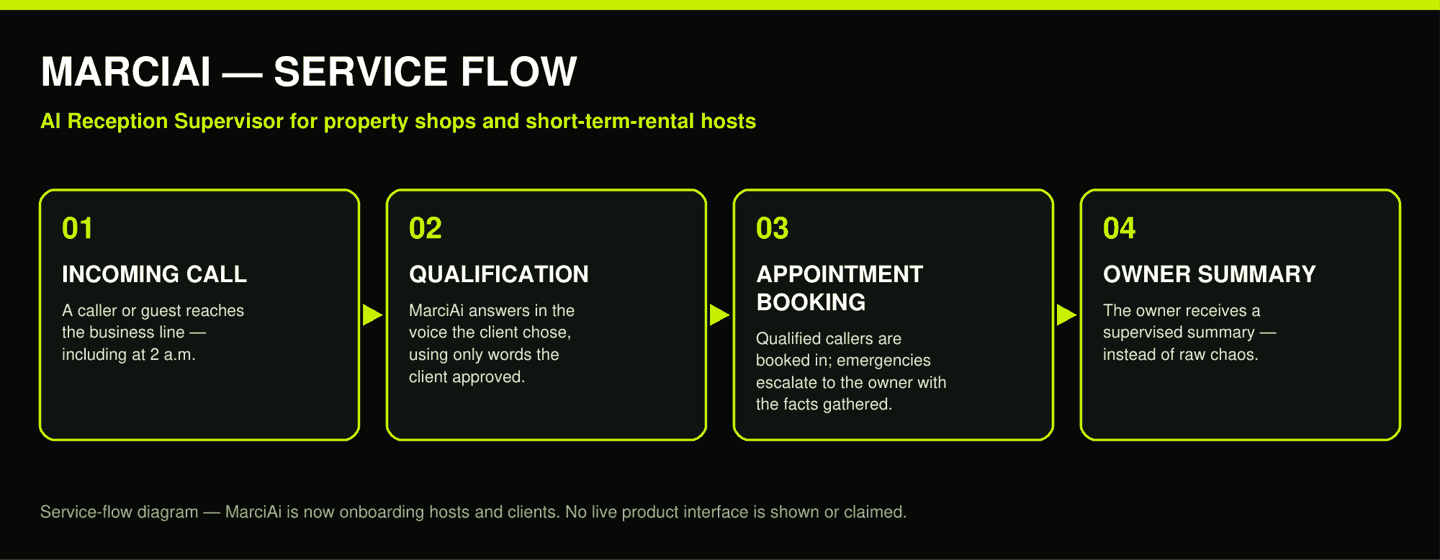
The front door of the office stack: an AI reception supervisor and service desk for property shops and short-term-rental hosts.
What it does: MarciAi answers and routes the phone in a voice the client chooses, trained on the client's industry and restricted to words the client approved. It qualifies callers, books appointments, and triages guest problems at 2 a.m.; emergencies escalate to the owner with the facts already gathered, and the owner receives supervised summaries instead of raw chaos. Its own one-pager states the status plainly — now onboarding hosts and clients — and nothing here claims a shipped product or a client result.
Proves: voice-AI product design · service design for a real trade · honest go-to-market discipline
View — visual page
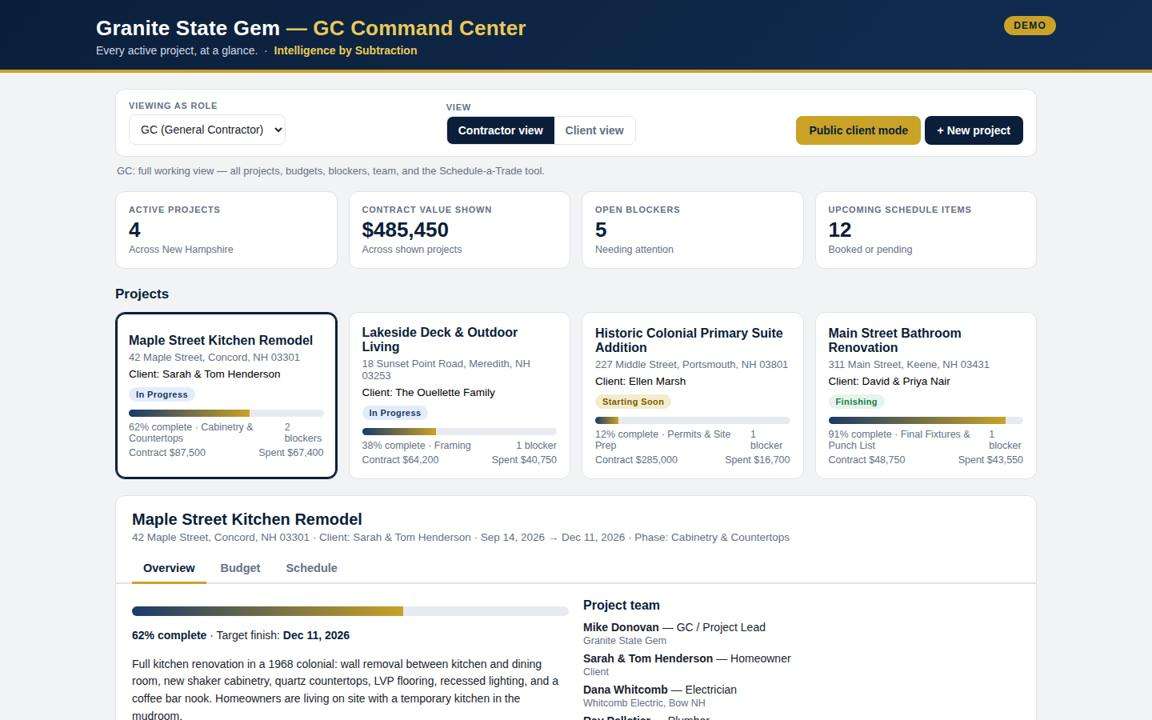
Granite State GC — Command Center
Live
A single-page command center for a general contractor: a project list with per-project budget and overview tabs, built and hosted at $0. All data is labeled fictional demo data in the README — that honesty is part of the work.
Proves: front-end delivery · dashboard design for a non-tech industry · scope discipline
Live demoGitHub repository
HSubtract Architect Studios
Horus *
Built
MarciAi's on-site companion — the "eye" of the stack, a real monitoring package (schemas, data, docs) in two private repos, Horus and Horus_Eye. It has never been run, and its early Vercel deployments error, so there is no live link to give; it is listed as a designed component of the stack, at exactly that weight.
Proves: systems thinking across a product line · edge / on-site component design
View — visual page
SSubtract Architect Studios
Sentinel *
Built
The security control plane of the stack, presented here as one product line — deliberately: the work currently lives in three private repos with colliding names (a control plane, a security protocol, and a second control plane), which is exactly the kind of cleanup this page's structure is meant to fix. The substance is architecture, specs, and invariants — a beacon baseline and a self-assessment tool still in draft — not a running service.
Proves: security architecture · verification-first design
View — visual page
VCSubtract Architect Studios
VaultCheck
Live
A complete command-line tool that checks email addresses against the Have I Been Pwned breach corpus and produces Excel reports. Pairs with the founder's Google Cybersecurity Certificate (2025) as a claim-and-artifact pair.
Proves: practical security tooling a buyer understands in one line
View — visual pageGitHub repository
Sparks Smart List *
Live
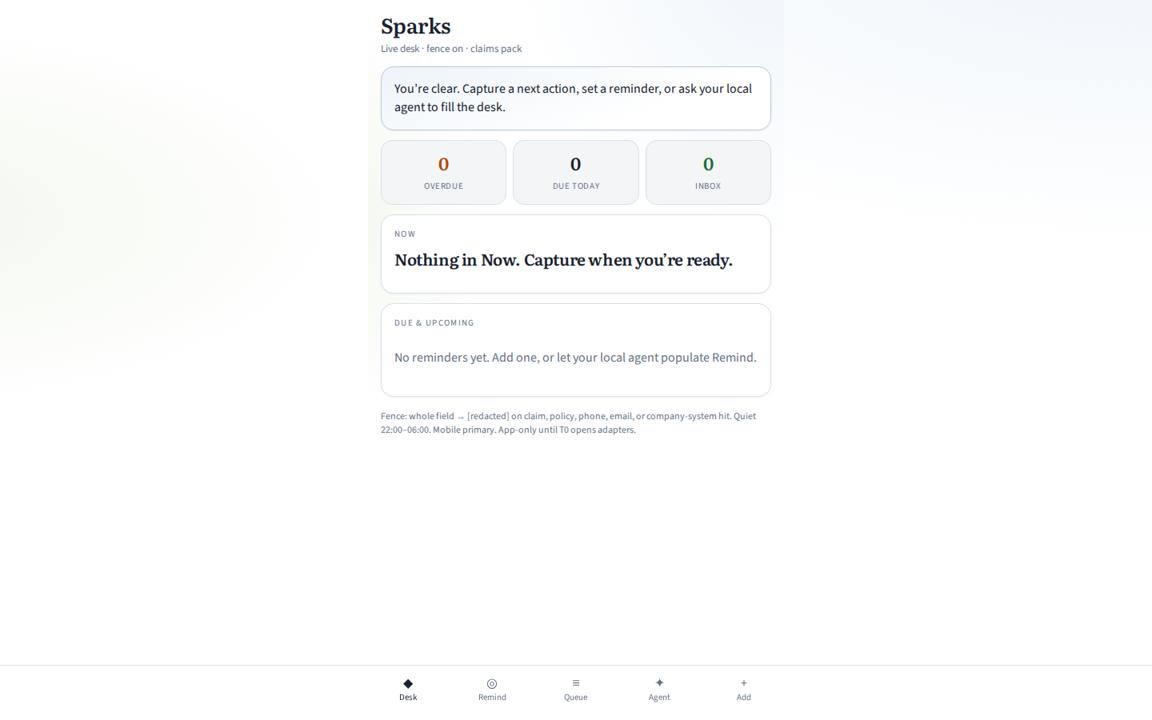
A mobile-first PWA dashboard built for a working claims manager — in daily use by a real user, with her data kept on her own phone by design: labeled reminders with quiet hours, an inbox / queue / log desk, and an agent-fill import format behind a redaction fence that automatically blanks claim numbers, policy numbers, phone numbers, and email addresses.
Proves: end-to-end delivery for a non-technical user · privacy engineering
Live app
RRSubtract Architect Studios
RentRoll Analyzer
Live
A data pipeline that ingests RentManager / AppFolio / Buildium exports and detects revenue leakage — vacant units, below-market leases, annualized loss. Written by a property manager with twenty years in the trade, for property managers.
Proves: domain operations depth + working data engineering in one artifact
View — visual pageGitHub repository
NESubtract Architect Studios
New England Real-Estate Compliance Registry
Live
A structured registry of landlord-tenant and housing compliance law across all six New England states, organized for working property managers, with a clear not-legal-advice disclaimer. Maintained as a working reference.
Proves: regulatory-domain depth · knowledge structuring
View — visual pageGitHub repository
UPSubtract Architect Studios
UploadIt
Concept-design
A multi-industry upload/intake platform for service businesses: one front door for customers to send documents, photos, and job details into an organized business inbox. The artifact today is a detailed build brief — the specification is the work, and it is not presented as a built platform.
Proves: product specification · platform scoping
View — visual pageGitHub repository
SSSubtract Architect Studios
Sub_Scribe *
Concept-design
"It writes what you meant." A speaker-intent correction layer for speech-to-text: personal vocabulary — names, places, coined terms — treated as first-class, so dictation serves the speaker instead of the statistically likeliest word. Requirements written by a founder who runs his working life on dictation. The requirements document is the artifact at this stage.
Proves: accessibility product insight from lived experience · requirements engineering
View — visual page
PMSubtract Architect Studios
Peace of Mind SMS *
Concept-design
A text-message filter built on the ternary method: messages from numbers not in your contacts are judged one at a time as they arrive — scams, spam, and threats quietly diverted, threats preserved as evidence and alerted on, and you always know someone reached out. The spec includes a 35-entry mobile-messaging threat registry and a production-hardening pass. In its own README's words: concept / spec phase — nothing is built, shipped, or live yet.
Proves: consumer-safety product design · privacy-first architecture (judge one message, never read the inbox)
View — visual page